Buying Land in Cedar Mountain: Cabin & Lot Guide
May 14, 2026
May 14, 2026
Dreaming about a mountain getaway in Cedar Mountain? It is easy to fall for the idea of a quiet cabin or a beautiful piece of land, but in this part of Transylvania County, the details of a specific property matter more than the postcard view. If you want to buy with confidence, you need to know how access, septic, wells, permits, and recorded restrictions can affect your plans. Let’s dive in.
Cedar Mountain is not a place where you can assume every parcel is ready to build just because it looks usable. Transylvania County does not have county-wide zoning, but county land-use ordinances still apply outside the jurisdictions of Brevard and Rosman.
That means a property can still be affected by rules tied to flood areas, watershed protection, mountain ridge protection, scenic corridors, and subdivision control. Before you treat a lot as buildable, it helps to review county GIS layers for flood, ETJ, and zoning-related overlays.
The county’s Cedar Mountain planning work also shows why local context matters. Parcels near DuPont State Forest or within the broader Cedar Mountain planning area may have very different site conditions from one road to the next.
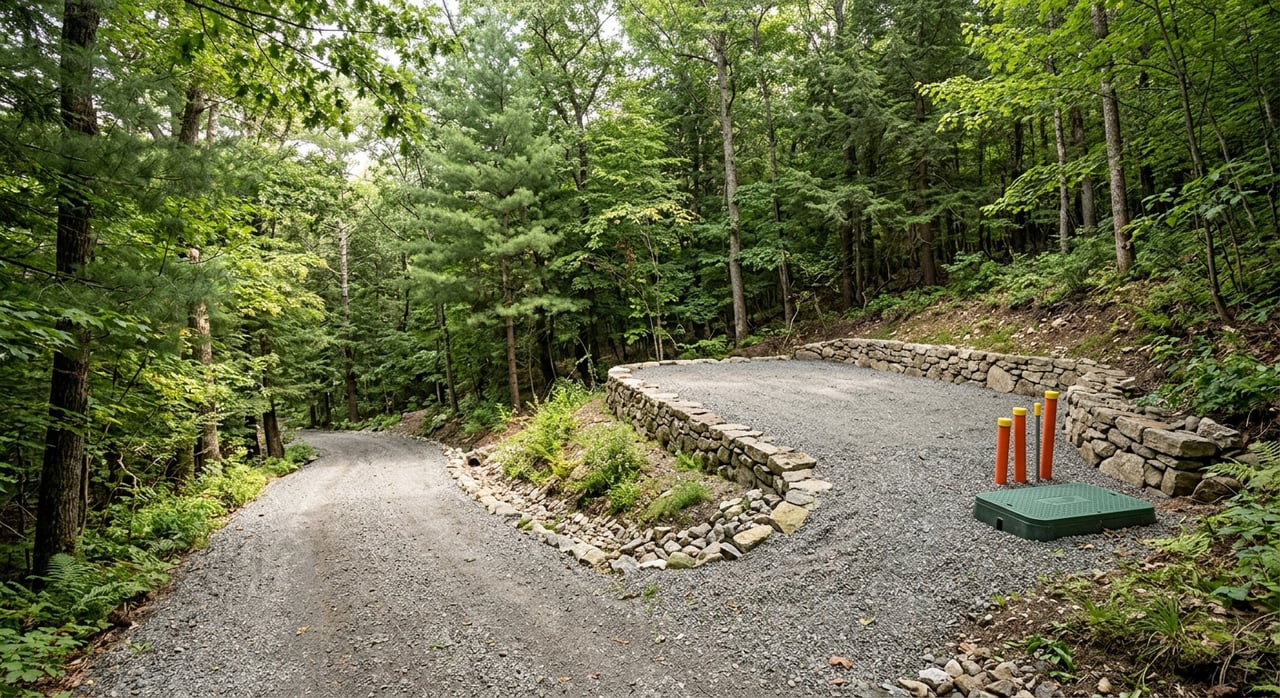
One of the biggest mistakes buyers make is focusing on the driveway surface instead of the legal access. In Cedar Mountain, a rough gravel approach may be fine, but you still need to know whether the property has a recorded easement, a shared driveway, or access from a private or public road.
Under county subdivision rules, a private driveway is a shared right-of-way or easement serving no more than two lots. A road is treated differently, and those distinctions matter for maintenance, utility access, insurance questions, and future building plans.
Private subdivision roads also have county standards. In hill terrain, they must meet design requirements that include a 45-foot minimum right-of-way and an 18% maximum grade, and dead-end roads need approved turnarounds.
If a subdivision road does not meet the 45-foot right-of-way standard, the final plat must include a warning that emergency vehicles and public utilities may have limited access. The plat must also note that NCDOT is unlikely to accept or maintain that road as a public road.
If a new subdivision road connects to a state-maintained road, NCDOT permitting and intersection standards may apply before construction starts. That is one more reason to confirm road status early.
Before you make an offer on land or a cabin, ask for these records:
In many Cedar Mountain transactions, the recorded access language matters more than whether the road looks drivable on showing day.
Mountain property can come with features that look appealing but create extra due diligence. Creeks, springs, low areas, and ridge lines can all affect what you can do on a parcel.
Transylvania County’s watershed ordinance protects the Cathey’s Creek water-supply watershed. The county building department also directs buyers to review North Carolina flood maps and floodplain permit requirements for designated flood areas.
For buyers in Cedar Mountain, this is not a box to check later. If you are considering building, clearing land, or changing a site, these map reviews should happen before closing whenever possible.
If you are buying raw land, utility questions usually drive the decision. In Cedar Mountain, the local process for private wells and septic runs through Transylvania Public Health and the county building office.
Transylvania Public Health permits and inspects septic systems and private wells. The county Soil and Water office can help with erosion-control information, soil maps, topographical maps, and access-road layout, but it does not perform perc tests or well site work.
For a new home without sewer service, the county requires:
An environmental-health specialist performs a soil-and-site evaluation to determine whether the parcel can support a septic drainfield. If site conditions do not change, the Improvement Permit is valid for 5 years.
Current county fees for FY 2025-2026 list septic permit costs at:
That matters because bedroom count can directly affect septic permitting.
Transylvania Public Health requires a permit before a private drinking water well is installed, repaired, replaced, abandoned, or destroyed. Wells must be drilled by a certified contractor.
New wells must be tested before being used as a drinking-water source. The county also recommends annual testing, plus retesting after repairs or flooding.
The current county fee schedule lists a private drinking water well permit fee of $500, including sampling after completion.
If your goal is to buy land now and build later, make sure your timeline includes local permitting. The county’s residential permit packet requires septic approval for new homes and additions, a GIS tax map or survey showing the new structure, and a site address for new construction.
If the site is not ready or property lines are not marked, the public-health page notes that a $50 site revisit fee can apply. That is a small detail, but it shows how important site preparation is in mountain construction.
The county also requires erosion-control measures for land-disturbing activity of 4,000 square feet or more. If disturbance exceeds 1 acre, state erosion-control review is required.
For buyers considering a log or timber-frame cabin, there is another key detail. The building department requires sealed plans from a North Carolina licensed design professional for those structures.
The county currently enforces the 2018 North Carolina Building Codes and the 2017 National Electrical Code. If you are pricing a future build, code compliance should be part of your planning from the start.
For many buyers, the real question is not whether Cedar Mountain is appealing. It is whether an existing cabin or a vacant parcel is the better fit.
An existing cabin often reduces uncertainty around immediate use, utility availability, and occupancy planning. Raw land may offer more flexibility, but it puts more of the burden on you to verify access, septic suitability, well feasibility, and permitability before closing.
Here is a simple comparison:
| Option | Main advantage | Main risk |
|---|---|---|
| Existing cabin | More clarity on current use and infrastructure | Remodels or additions may still trigger septic and permit review |
| Raw land | More freedom to shape future plans | More unknowns around access, well, septic, grading, and permits |
If you are buying a cabin with plans to expand, remember that existing septic system authorization may be required for many additions or remodels, especially if bedroom count changes or the septic system must be moved. The county also requires final septic or sewer approval, a final termite certificate, and a well construction report before electrical power is released or a Certificate of Occupancy is issued.
A beautiful mountain setting does not override recorded restrictions. North Carolina law requires sellers to provide a Residential Property Disclosure Statement and, when applicable, an Owners’ Association and Mandatory Covenants Disclosure Statement.
That association or covenants form should identify items like dues, assessments, transfer fees, services paid through dues, pending lawsuits or judgments, and land-use restrictions affecting the property. Buyers should ask for this packet before making an offer.
Under North Carolina law, the required disclosure statements must be delivered no later than the offer stage. If they are missing or late, a buyer may have a statutory cancellation right.
For raw land, ask one more important question: have any mineral rights or oil and gas rights been severed? North Carolina requires a separate disclosure for those rights, and the issue can matter when value is tied to acreage, timber, or long-term holding plans.
Listings are helpful, but county records are where you verify the details. The Transylvania County Register of Deeds is the custodian of real estate records and offers access to deeds and related documents.
That makes it the key place to confirm:
If you are comparing several Cedar Mountain properties, this record review can quickly show which ones have a cleaner path forward.
Buying a cabin or land in Cedar Mountain usually goes more smoothly when you line up the right people early. The most useful local contacts often include your buyer’s agent, county Environmental Health, the Building Permitting office, the Register of Deeds, a certified well contractor, a home inspector, and any surveyor or engineer needed to verify boundaries, access, grading, and site feasibility.
North Carolina disclosure law also allows an owner’s report to rely on written information from professionals such as a home inspector, land surveyor, engineer, geologist, or contractor. In a mountain market, expert input can save you from expensive surprises.
If you are serious about buying a cabin or land in Cedar Mountain, focus on the property’s facts before you fall in love with the view. Legal access, map overlays, septic and well feasibility, permit requirements, and recorded covenants will shape what the property can actually do for you.
That does not mean mountain buying has to feel overwhelming. It just means the right local guidance and a thorough review matter more here than broad assumptions.
If you want help sorting through Cedar Mountain cabins, lots, or acreage, reach out to Heather Scott for local guidance rooted in Transylvania County experience.
Stay up to date on the latest real estate trends.
October 15, 2026
October 8, 2026
October 1, 2026
September 24, 2026
September 17, 2026

September 10, 2026
September 3, 2026
August 27, 2026
August 20, 2026
Reach out to for expert real estate services. Buy, sell, or rent properties with confidence. Contact us today!